

Todd Colby
I. “Punk the Fuck Out”
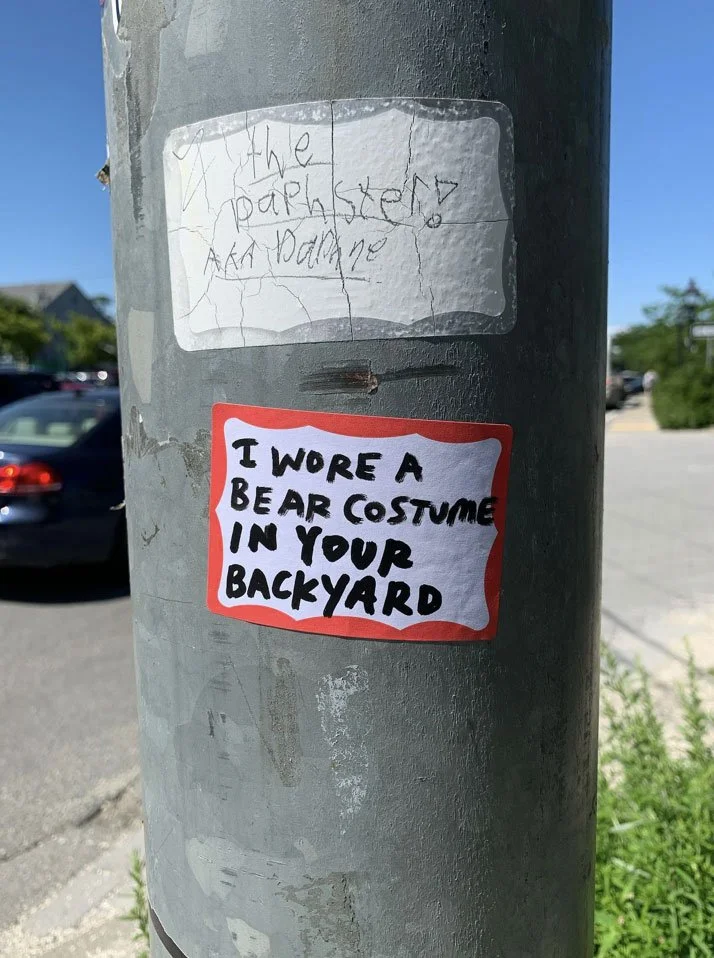
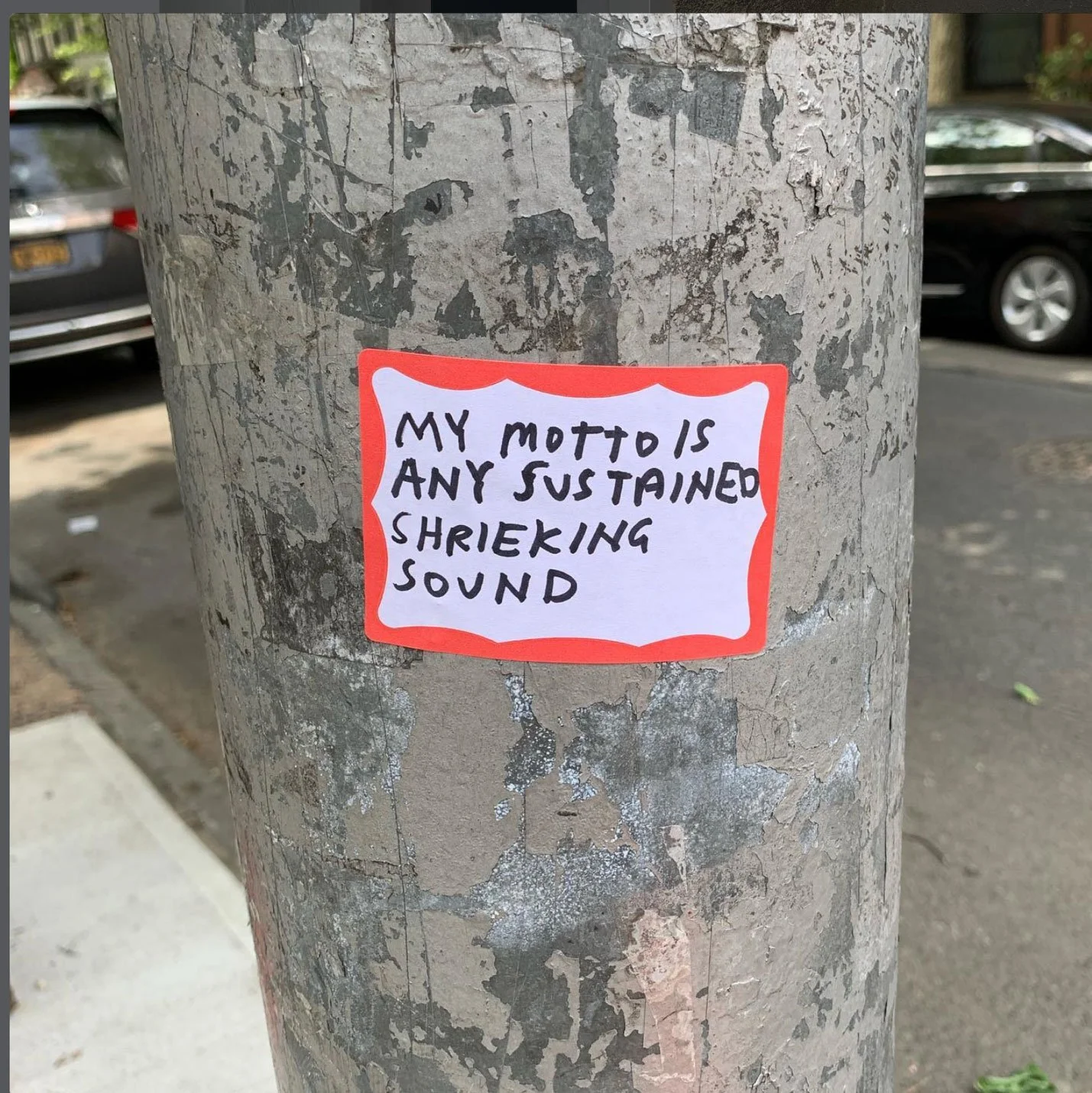
Todd Colby’s work spans multiple genres and positions of mischief. He’s a punk—a sweetheart too. His words and images—on canvas, in chapbooks, on stickers he posts, usually giggling, on lampposts and the backs of STOP signs—swirl into the darkest darkness, yet somehow come back up with the kindest light.
What is it about work reassures by naming an ache?
Quite Broken: We hear you’re just back from New York City.
Todd Colby: 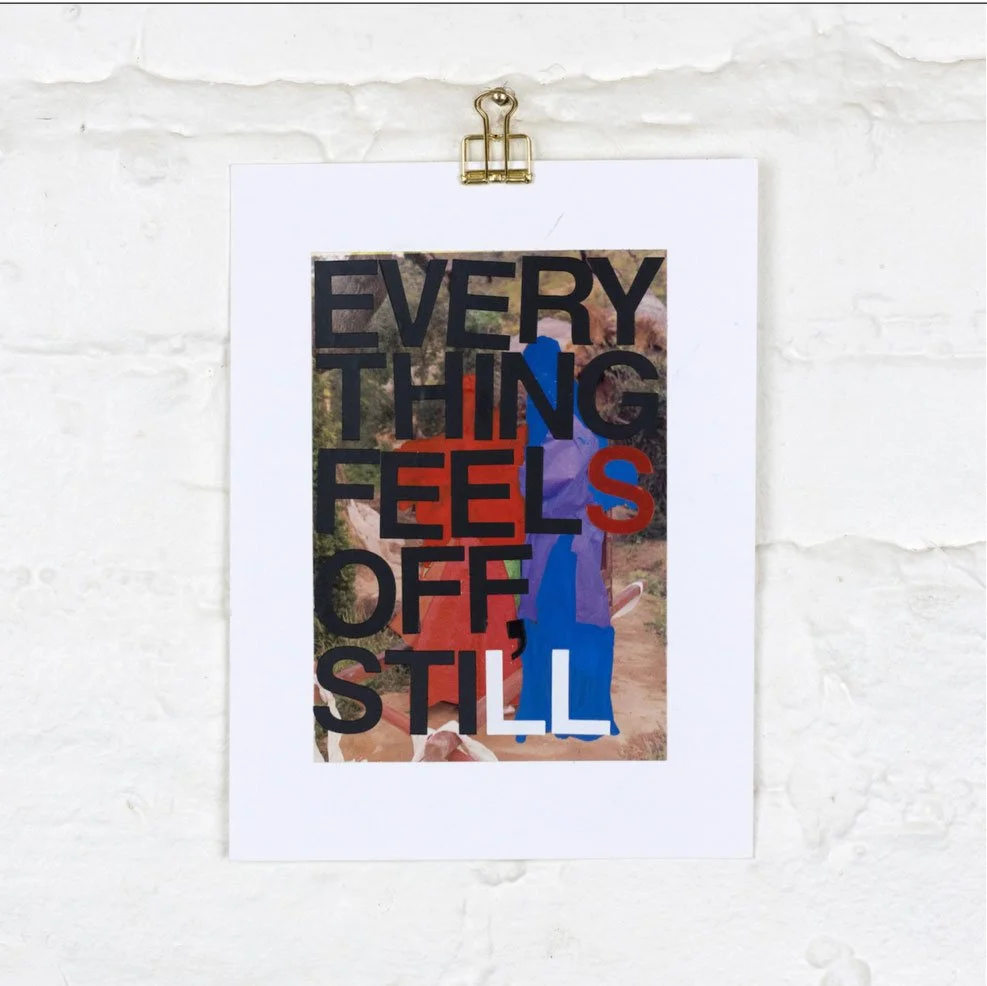
Images courtesy The Picture Room, 117 Atlantic Ave, Brooklyn, NY
I had a reading at Bowery Poetry Club. It was deeply moving. Two of my mentors were sitting in the front row: Ed Friedman, who ran the Poetry Project at St. Marks Church for years and Bob Holman, who ran the Nuyurican Poets Cafe. They were sitting in the front row right next to each other and smiling the entire time. They were the first people to invite me to read, to sit on the board of the Poetry Project, what I thought were these monumental tasks. To have them come up to me afterward, beaming, it felt really good. I was contained, but exuberant.
Quite Broken: We hear you’re just back from New York City.
Todd Colby: I had a reading at Bowery Poetry Club. It was deeply moving. Two of my mentors were sitting in the front row: Ed Friedman, who ran the Poetry Project at St. Marks Church for years and Bob Holman, who ran the Nuyurican Poets Cafe. They were sitting in the front row right next to each other and smiling the entire time. They were the first people to invite me to read, to sit on the board of the Poetry Project, what I thought were these monumental tasks. To have them come up to me afterward, beaming, it felt really good. I was contained, but exuberant.
QB:
Contained But Exuberant: The Todd Colby Story. That could be the title of your bio-pic.
TC:
Exactly. And I just had therapy two hours ago, and I was talking about how it feels to feel good. Feeling good feels good. What feels especially good is feeling good without immediately thinking of the bad things, or even what I should feel bad about. It’s like … life is so short. Being in that room, knowing how many poets have died in the past several years, how quickly we’re all gonna go. Five years from now, half that group won’t even be there. The fleetingness of it all just let me embrace it.
QB:
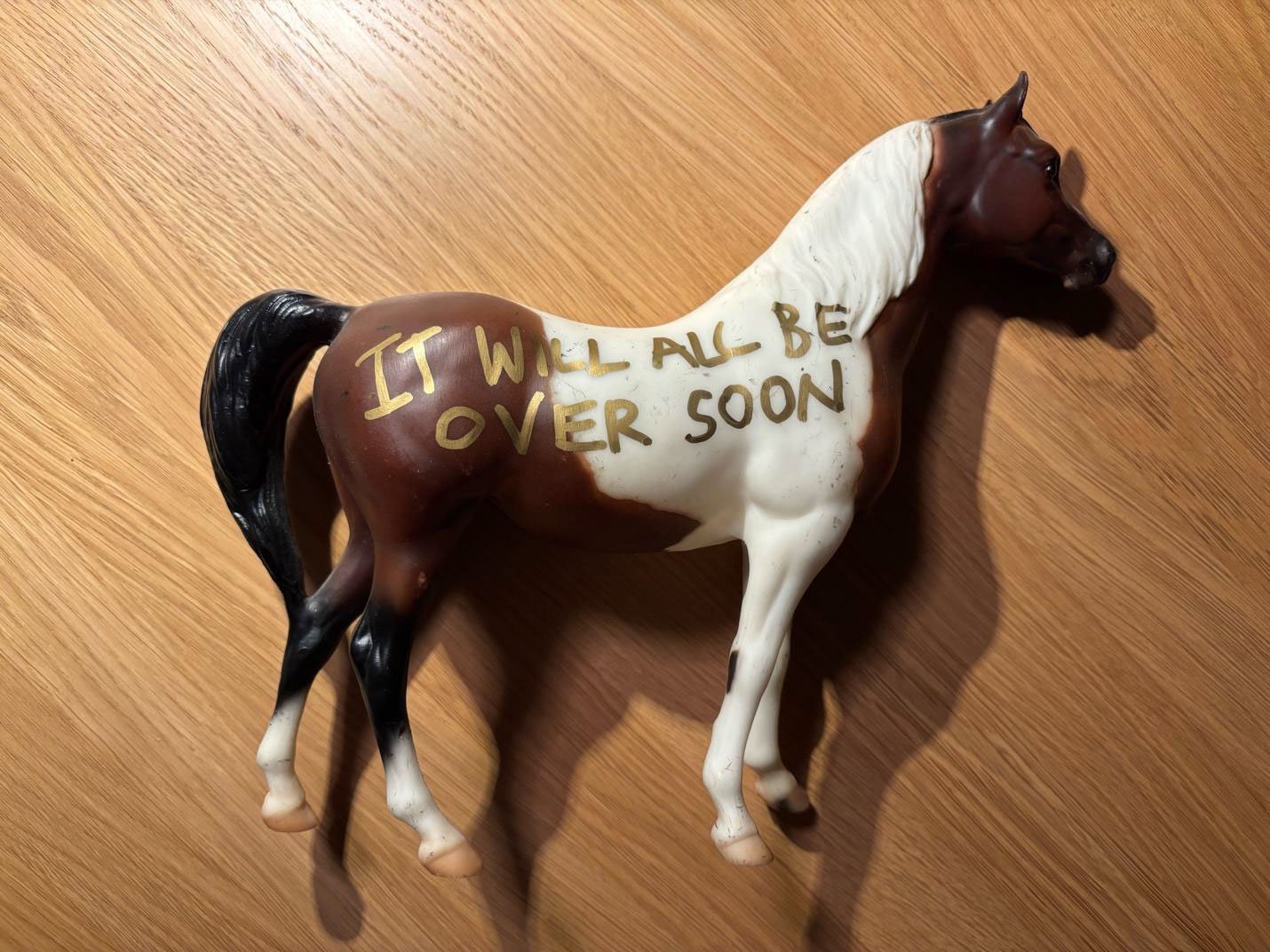
It reminds us of something you often say, which is so Todd Colby in its mix of grim delight, or delightful grim—it’s just so reassuring on an existential level when you say, remind us of the phrase, it’s something like, “Don’t worry about it, it will all be over with soon anyway”
TC:
Yes, that’s it.
II. “Punk the Fuck Out”
Todd got his start writing lyrics and singing lead for a band called Drunken Boat, and he came to New York City in the 1980s, at a time when communities of artists were ravaged by AIDS. He talks about feeling the “decimation” of tha time, yet seeing artists (like David Wojnarowicz) whose spirits, while besieged, also roused to true and beautiful responses.
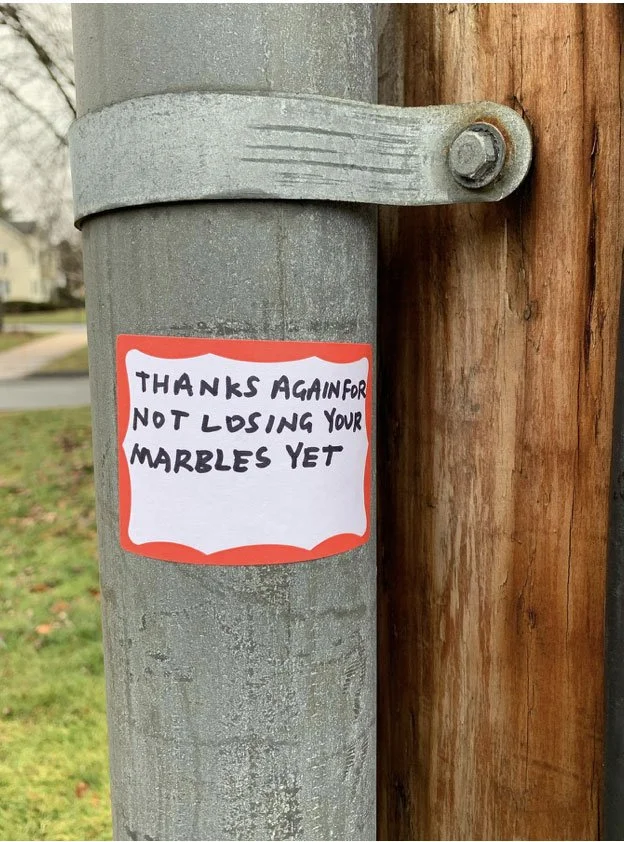
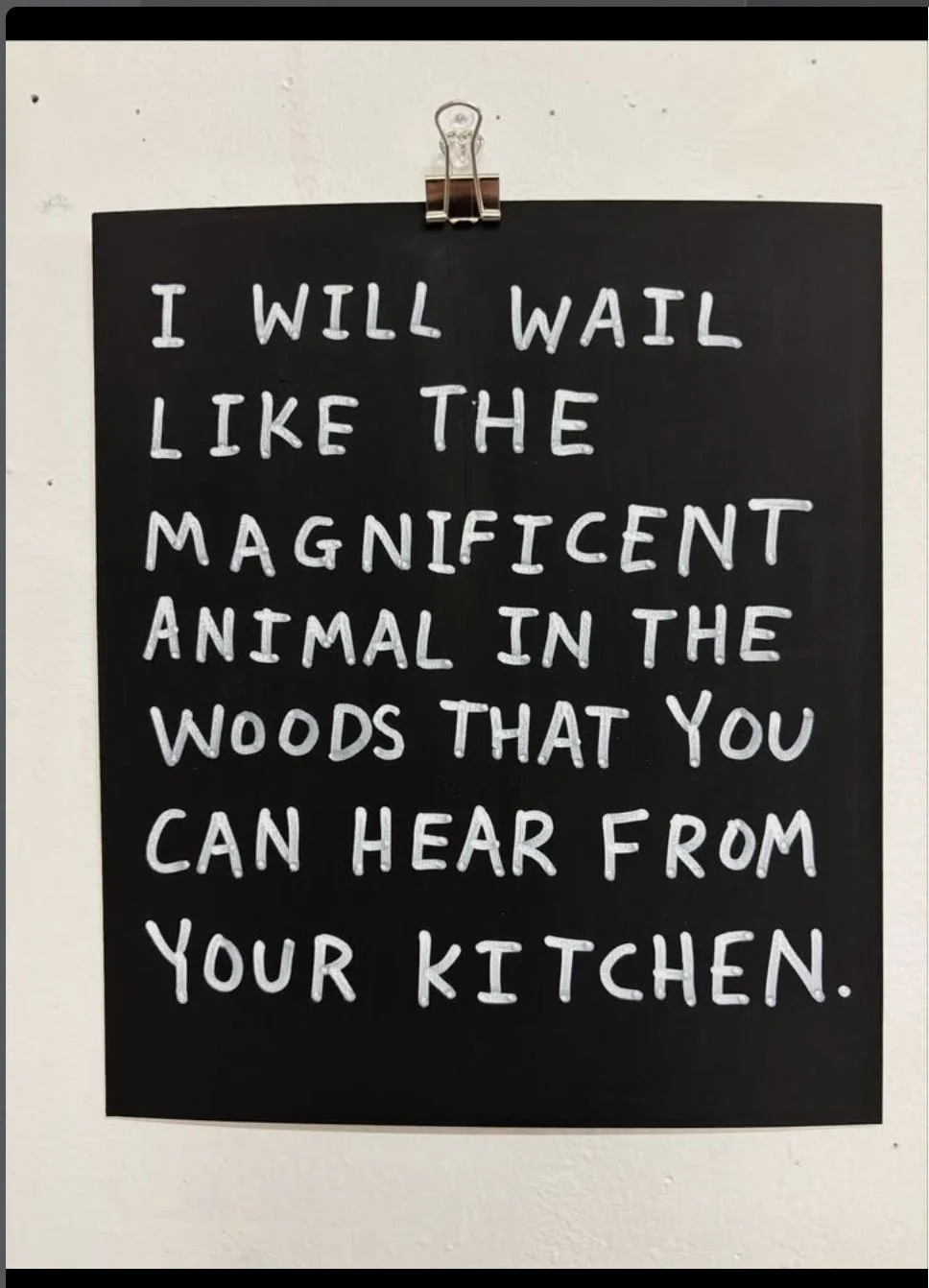
QB: OK, before we go any further, I have to ask, is 4:40 p.m. Eastern on this particular Tuesday a good time to punk the fuck out?
TC: Let’s punk the fuck out. Anytime.
QB: For people who don’t know the reference, you made a piece we love and think about all the time, that says “When you’re full of worry and doubt, it’s time to punk the fuck out.” We always ask you, “Would now be a good time?” The answer is always yes. What does the phrase mean to you?
TC: It has a variety of meanings I guess but usually it comes up when I feel nervous, scared, questioning, overthinking—when I’m grinding. Then it’s like: it’s time to punk the fuck out. It gives me courage. Alice Notley once told me—when I was hemming and hawing—“Sometimes you just have to pull your pants down and slide on the ice.” That’s the equivalent. You can overthink how cold it’ll be, how uncomfortable… but sometimes you just gotta fucking do it.
III. “Mischievous Interventions”
Todd’s six volumes of poetry include Splash State, Tremble & Shine, and Riot in the Charm Factory, and he’s noted by the Academy of American Poets and the Poetry Society of America. He also puts images and words on canvasses and … what do we even call his stickers that go up on the streets?
QB: How do you even describe those small text pieces—these little interventions?
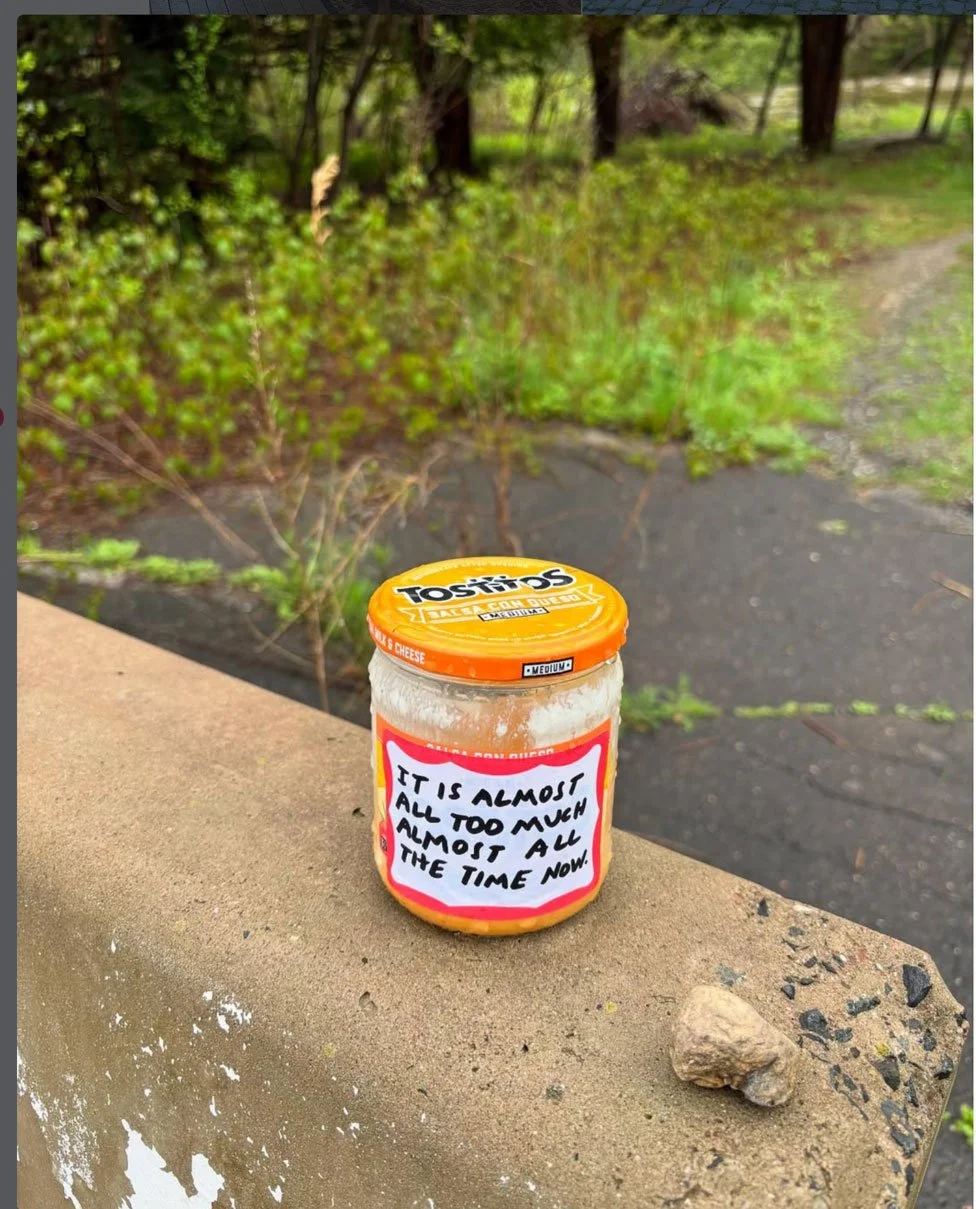
TC: “Intervention” is a good word for it. It started in New York City, and I really did want to interrupt these spaces we take for granted. Suddenly a message appears. The first word that comes to mind is mischievous. Naughty. You could pass right by it, but you might think about it. I don’t write them with an audience in mind. I write a lot, then I pick through things that reverberate.
And the form forces compression. The stickers are from standard packs, Avery Name Badge Labels #5143, with a red border, and they leave a just few inches by three and a half inches to write in. It’s about the same space as a postcard. If you write too many, it’s crunched. So you’re constantly editing down, trying to get to the essence. Almost like a haiku.
Part of it is wanting to jam up the machine a little bit. To be a trickster. And it’s competing with all the other stimuli on the street. But people notice. They take pictures. They post them. I’m so honored that happens.
IV: “I Existed”
Why do we make art? The writer and teacher Robert Olen Butler says the heart of fiction is yearning. We wonder about where it comes from. Is it a yearning for relief—or to connect? Or just to be seen?
QB: Where did that impulse start—writing on objects, leaving messages?
TC: When I was a kid, we moved around a lot. My dad worked for Hormel, the meat company known for SPAM®. We lived in Austin, Minnesota; Atlanta, Georgia; Ottumwa, Iowa. In every house there’d be a hot water heater in the basement, and I’d secretly write on the top of it—my name, random facts. I also wrote on the bottom of my nightstand, and I left notes in the back of closets under the shelves, really stuffed back in there. I hoped some other eight-year-old boy would find it, like a communication through time.
That’s the same impulse to put a sticker on something. Or the journals I keep. It’s just: I want a record I was here. I existed. I saw this. I felt this.
And yeah, I wanted my parents to not just acknowledge it but admire it. I’d draw pictures for my mom—flowers, still lives—offerings. I’d wake up early on Sundays, seven years old, work hard so it would be done when she got up. I wanted her to put it on the fridge. It was like: See me better, love me more.
She acknowledged it enough. But not enough. So it kept me going. In a Lacanian sense, she maintained my desire because it was never fulfilled.
IV. “Nothing is Special. Everything is Permitted.”
Todd wakes up early, goes to a quiet room with a stiff cup of coffee, and writes in his journal. Later in the day he takes his dog, Honey, to a studio in an old toothbrush and plastics factory, where he spends much of the day making paintings and drawings. He’s impatient with any other work ethic than a total one.
QB: When you move it onto canvas, does it lose the transgression?
TC: No, the medium isn’t a problem at all. The problem is how do I trick myself into beginning without getting precious. Max Jacob said more poems are killed by sitting down to write them than anything else. The act of saying “I’m going to write a poem now”: that’s deadly. So I back into it. Nothing is special. Nothing is important. Everything is permitted. Stakes are low.
Even if the canvas isn’t cheap, I have to treat it like it is. It’s an educated impulsivity. I have a palette, a plan, but I need to get to that first point of doing it. Then I’m less self-conscious. Like Now I’m Working on a Painting. I’ve got to let go of that baggage every day. My mom reminded me once that she and my dad bought me a desk when I was five and I’d sit there drawing nonstop. Whatever that universe is, it’s been available to me since I was little.
V: Endurance as a Classroom
One time we visited Todd’s sixth floor apartment in Brooklyn and we were puzzled to see, hanging from the doorknob of his small writing room, an astonishing number of medals from the Ironman, a famous endurance event that includes a 2.4-mile swim in open water, a 112-mile bike ride, and a marathon run, all completed in one day.
When we found out that, yeah, these were Todd’s medals for doing those races, that data point became a dot in one of those connect-the-dots exercises you have to do with artists, where you deliberately look for outliers and then you see that it’s all creating a picture of their peculiar soul’s expression. In Todd’s case, the picture has to do with a kind of ferocity of commitment, combined with a kind of monkish non-attachment.
QB: We’ve always wondered how the Ironmans fit into your character. What do you think?
TC: Well, I wasn’t always physical at all. As a kid I was uncoordinated and overweight and I got teased mercilessly—by my classmates and, even worse, by my own family. I’d say I was bullied. Then at some point I just made a decision: I’m not getting any help at home, so I’ve got to take care of myself. So I got into sports. I played football in high school. I was a linebacker. It was also a way to make friends and fit in.
Later the more extreme stuff like the Ironman—this was like breaking through to another side. You go through every emotion in a lifetime during those 12 hours: despair, rage, elation, unification with the universe. And you learn each thing passes through you. It’s the worst pain I’ve ever been in: brutal cramping, can barely stand upright. But you keep moving. It sounds stupid, but it taught me my limits… and then taught me I could persist past what I thought were my limits, surprise myself with new limits.
The art of it is sort quite like the art of making art, just breathing, finding rhythm, watching the sensations in the body. I used to do hundred-mile rides in Prospect Park. That’s five, five and a half hours, looping around that asphalt path. At a certain point, the bad thoughts burn off, and then what you’re left with—that’s the question.
VI: Bringing the Poem to the Room
A lot of times these days art getas mixed up with content, like it’s just a thing to fill up space or get attention. But Todd’s work is like a joke your friend told you, and you’re laughing so hard that the original phrasing recedes into the glorious mist of the mirth. What he’s doing is making a feeling, or naming his own, and it’s evanescent, but that’s the only thing that endures, right?
QB: What role does performance play in your work. So much of what you do seems like it strides the line between making and shouting out, between inhabiting and manifesting somehow.
TC: In seventh grade I found a two-volume book called The Poetry of Rock. It compared lyrics, like Leonard Cohen’s, with someone like Dylan Thomas. This blew my mind—rock mixed with poems I thought were old and dusty. That was my introduction to the idea that raw funky things could be poetry. Then Jim Carroll changed my life. Patti Smith. The poet-rockers. I was like: I know my calling. I want to jump into that fire and I finally got in a band.
I never felt so good as I do onstage. There’s no drug like it: connection, oneness, ecstasy. I didn’t play an instrument, but to be the one singing, setting the tone, being the mood of the room… huge responsibility. Time stops.
The lyrics were written, but we recorded every rehearsal and left room for improvisation. I brought notebooks, used phrases, poems. There was no difference between poems and lyrics.
I also got frustrated with the poetry world at one point. Being a frontman gave me freedom— movement, interaction. So I started challenging audiences at readings, going into the crowd, trying to surprise people. Eventually I found a home at the Nuyorican Poets Café—where you didn’t just read quietly. You lived the poem. DJs, dancing, skin-to-skin, cigarettes, then back to poetry. Every kind of New Yorker in the room. It felt like hope.
VII: “Attachment to Suffering Doesn’t Help Me Make a Contribution”
QB: Maybe the through-lines is the hope found in that noble nerve that runs through all of us, the reminder that there’s a wholeness of some kind, it runs among us, it pulses inside us, it even sits at the edge of mortality.
TC: Some days it really seems that everything is trying to keep from that—like, it’s diabolical. Trying to keep that feeling at bay as much as possible, and I’m talking about old conditions but also these really pernicious forces that feel unusually rampant right now.
QB: And what’s the role of art at a time like this. At worst we’ll have to be like Solzhenitsyn and just cup our hands around the smallest flames to keep the light alive?
But we want to ask you—the Quite Broken project has a question at its core, which is where can art offer care or clarity or succor that medicine misses? Do you see your work as a kind of address to suffering?
TC: I don’t know. There’s a tradition—especially among men writers—of almost courting disarray in order to deepen your part. So many romantic ideals around that. And I love Jack Kerouac; he changed my life. But God he was so self-destructive. Myself I don’t feel I need suffering to generate art, and it’s quite important to me to occupy that space. I look at the people I admire—Eileen Myles, Amy Sillman, John Ashbery—and I see how they played the long game, how they really ran a marathon with their careers.
But even if suffering does initiate art, I guess I’d say real beauty gets beyond it. Life hurts, and yeah, I look at that. But a romantic attachment to suffering doesn’t help me make a contribution. If I’m courting suffering, the art doesn’t work.
What matters more is looking for things I can understand and forgive or love—engage with in a way that makes you feel connected.
QB: So play and joy are central.
TC: All the time. Nonstop. I choose that path.
Of course the question of suffering is central to anyone who considers how to proceed through life in the face of inevitable pain. Myself I feel like I’m lucky in that Iv’e dealt with pain and I often feel a little lighthearted about it—a little motivated by it, whatever.
QB: It feels sometimes like there’s an existential mirth as you hover over these difficulties.
TC: Well the main thing is you’re not alone in these feelings. You know I come from this Scandiinvain-Midwestern harshness that made you embrace these ironic tragedies, if you will. It’s not like a Episcopalian fron the city—it’s fatalistic to. These Swedes and Norwegians
left this dark cold area of the world to move to someplace even darker colder and more remote and without any availablility of anyone. They clearly knew how to entertain themselves. They knew how to fill up that void. I have that DNA. I may despair. There may be a lot of suicides in my family. Every people can say that, but I’m constituted somehow to poke my finger in its eye. And take a quiet pride in it. My grandfather would be out in those things ice cold three a.m. weird pleasure in that suffering. It justifies being a human. Something is justified. It feels kind of catholic in some way. You sufer for your sins. You’re absolved.
My mom became a nurse and she would take great joy telling us a story about a kid getting stitches all the way up to his chest. It always felt like this interjection of utter chaos and devastation and injury— but there was also this weird jouissance, to quote Lacan again, this pleasure in the awful pain I remember this one time a kid was having a convulsion at Six flags. My mom jumped up and knew what to do but more than that there was just this sense of being available to those huge hard surprises. I think I was programmed to look for that at all times. Which makes me anxious as fuck. But makes for good art.
QB: Reassuring someone is easier than it seems.
TC: And I’ve also done the opposite one: “Reassuring someone is not as easy as it seems.”
QB: It’s always seemed to me that that was an impulse of yours. That the work has an impulse to reassure.
TC: [Pause.] But with a pinch of cayenne sarcasm. There’s gotta be a burn to it. Wasabi mixed into the sweetness.
VIII: “One Crying While the Other Ignores Them”
QB:
When we think of your sense of play and joy—we know you’re fastidious about what you wear and how you make space—there are matters of style for you that are also matters of comfort. And yet you have this body of work that so totally explodes the bourgeois assumptions of domestic interiors, oneof our favorites of what you’ve done.
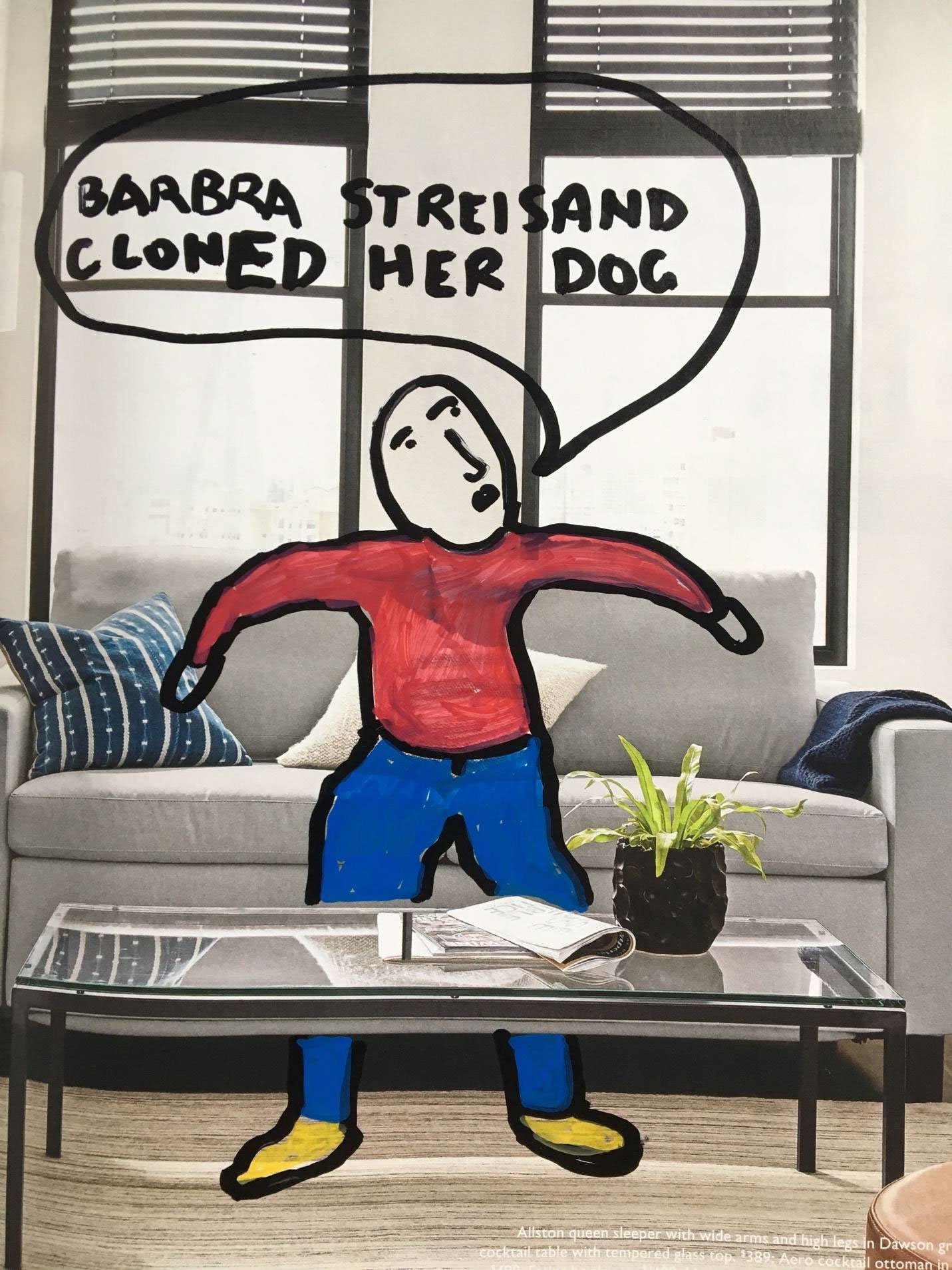
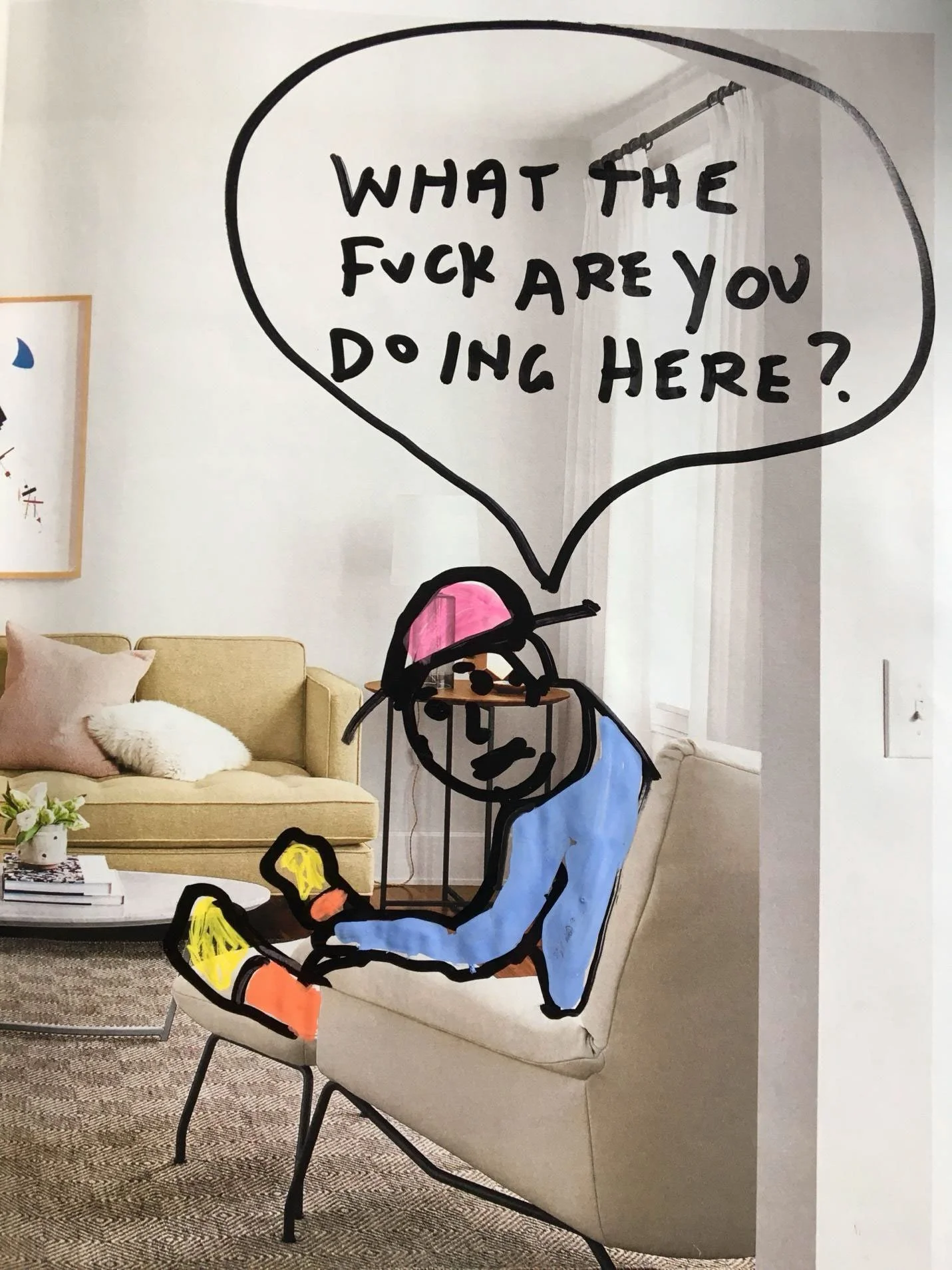
QB: Tell us about catalogue pieces.
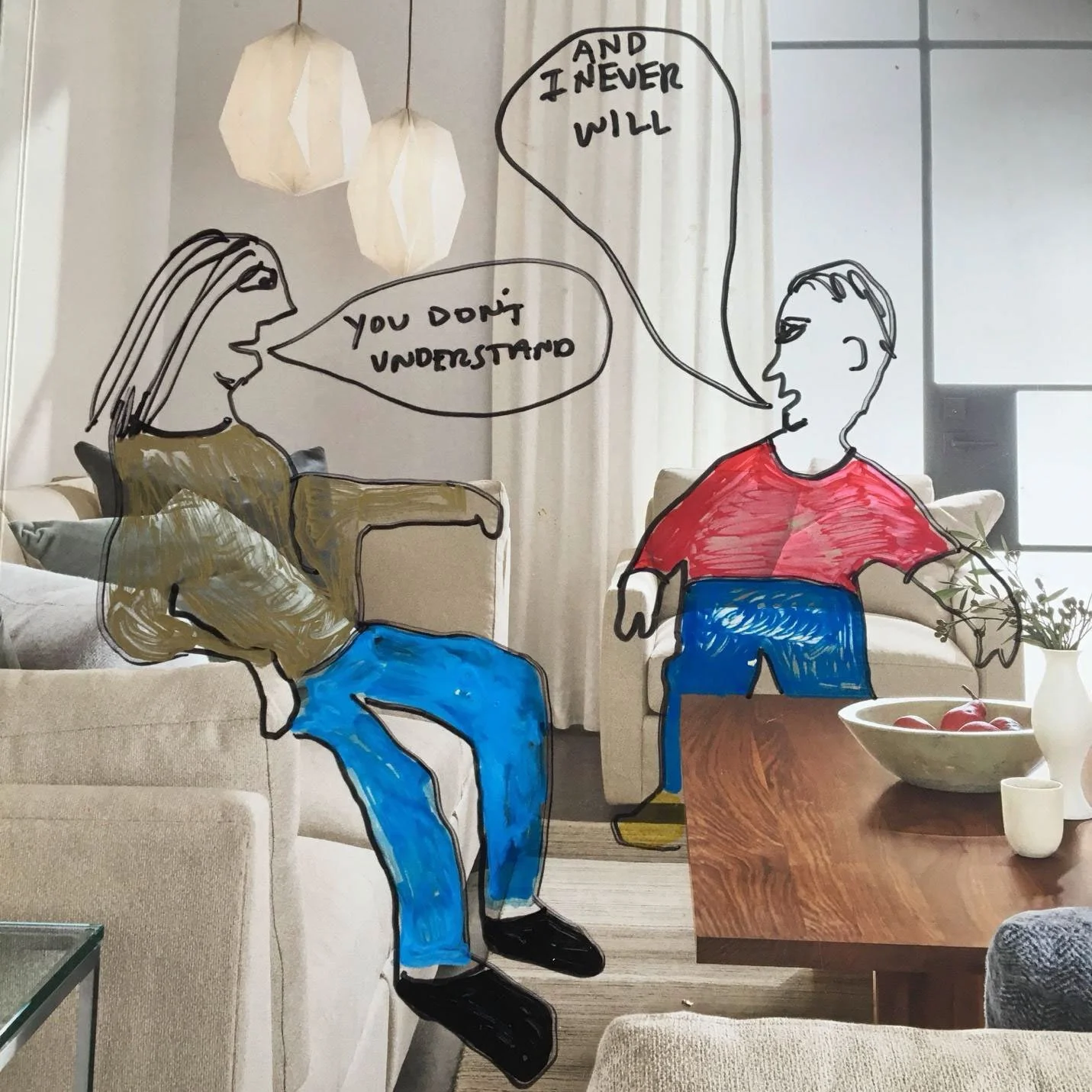
TC: In 2009 I got divorced and I had to move to a new apartment, and I had to get furniture. I went to IKEA and I looked around at all these little tableaus they’ve made, you know, the cozy breakfast nook, and the little junior modern TV room, and what I kept seeing, in my mind, were couples splitting up—arguments over breakfast, one crying while the other ignores them. That’s all I saw.
Then I had these furniture catalogs. I ran out of paper and started doodling figures on top. There are no humans in those pictures, no sign of life—no stain, no glass—just sterile. It felt good to put drama in it.
I felt like a dramatist. Like a playwright. The rooms were stage settings. What would happen here? What conversation have I had in a room like that? Disturbing or funny. I became obsessed. It was an exorcism of domestic stuff.
QB: Todd, we just want to name the obvious thing that we love your work, that you're a spirit animal for this whole project, which we’re still trying to figure out what it even is. Somehow it is about the wisdom of the arts as a balm and as a guide, which is what you are. So thank you.
TC: It’s such a beautiful conversation, though there’s something hard 0- whatever grasping at this tiny thread is so easy to gnaw away.